


 Menu
Menu
- Bestsellers
- New Arrivals
- Mini Waffle Blocks
- Micro Waffle Blocks
- Midi Waffle Blocks
- Maxi Waffle Blocks
- Waffle Blocks
- Construction Wheels
- Building Bricks Blocks
- Junior Brick Blocks
- Classic Blocks
- Vehicles for Children
- Sand Toys
- Toy Containers
- Accessories
- Blocks by Age
- Building Blocks for Schools and Preschools
- Products on sale
Browsing options
Pieces
Price
-
from
to

€65.23
Regular price:
€72.48

€6.28
Regular price:
€6.98
€24.95
Regular price:
€27.73

€2.45
Regular price:
€2.73
€8.53
Regular price:
€9.48

€3.80
Regular price:
€4.23
€11.23
Regular price:
€12.48

€31.48
Regular price:
€34.98

€7.40
Regular price:
€8.23

€20.23
Regular price:
€22.48
€8.53
Regular price:
€9.48

€33.73
Regular price:
€37.48
In public institutions, practicality matters most—teaching aids are in constant use, passed from one child’s little hands to another. Building blocks for preschools should be more than just a toy—their main purpose is to support the achievement of educational goals and the development of teachers’ competencies. It is important to note that construction toys are not merely an add-on in a child’s education. They are an element included in the requirements of preschool education—by the time a child finishes preschool, they initiate play, create, tinker, and build. That is precisely why educational blocks in preschool and school have become a standard—and why Marioinex’s offer is a natural choice for these institutions. Are you interested in blocks for preschoolers? You’re welcome!


Mini Waffle - Animals SAVANNA 100 pcs

Availability: trwale niedostępny
€20.23
Regular price:
€22.48


Brick Junior 40 elements: windows + doors

Availability: Towar niedostępny
€19.10
Regular price:
€21.23
Building Bricks with Wheels 30 pcs

Availability: trwale niedostępny
€150.50
Regular price:
€167.23


Marioinex blocks for preschools and schools – educational sets for learning through play
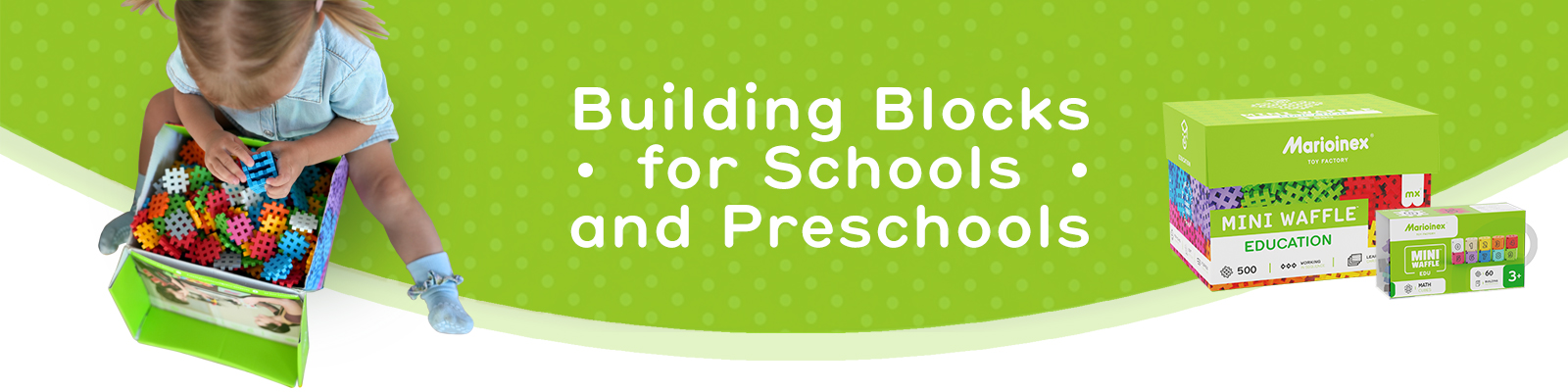
In educational institutions, the best solutions are those that combine three key elements: scale (large groups of children), methodology (specific exercises), and durability (everyday use of the toy). From a school’s perspective, sets from the Mini Waffle EDU line work particularly well. These sets include a large pool of classic Mini Waffle blocks, as well as a set of educational cards and a task booklet—especially in the larger sets packaged in carry cases. The cards make it possible to complete the tasks described in the booklets, such as imitation, filling in missing elements, and continuing sequences. This means less preparation time for teachers and an easier way to implement educational blocks as teaching aids in both group and individual activities.
Why are educational blocks a standard in public institutions?
Blocks are one of the most universal tools for learning by doing—which is confirmed by research.
-
They show that spatial skills and building structures with blocks are linked to math achievement from an early age.
-
Interventions based on (semi-)structured block play can support the development of mathematical skills and executive functions in preschool children.
-
In school practice, blocks also serve as a great “bridge” between action and mathematical symbols—helping children move from manipulation to mathematical thinking.
For schools and preschools, this brings tangible benefits: teachers get full support in the form of teaching aids that cover many areas of child development—for example fine motor skills, STEM education, and social competencies.
Marioinex blocks – what makes them stand out in preschool and school?
Marioinex blocks are a great product that stands out among learning materials for the youngest children:
-
Ready for teaching work, not just “go play.” Mini Waffle EDU block sets include educational task cards. Their friendly graphic format encourages learning through play without creating negative associations.
-
Safety and standards important in public institutions. Schools and preschools follow specific requirements and guidelines. One such requirement for toys is the CE mark, which stands for European Conformity. It is the manufacturer’s declaration that the product meets all European Union legal requirements—mainly those related to safety, health, and environmental protection. The CE mark allows the product to be freely marketed in the EEA (European Economic Area). It indicates that the product complies with all standards set out in EU directives. CE marking is required, among others, for toys, electronics, and machinery. In practice, this mark signals that the product does not pose any threat to living organisms.
-
Group work without frustration. School and preschool have their own rules. With large groups of children, logistics matter a lot. A good example is purchasing large sets—they allow children to work in parallel, learning teamwork in groups or pairs.
When choosing blocks for a preschool, it’s worth making a checklist of the conditions the toy should meet to ensure it is appropriate for children of a given age. A very important aspect is the CE marking—the European conformity mark confirming that the manufacturer meets the requirements set out in European directives and regulations. It’s also worth remembering hygiene and keeping the toy clean. It helps to designate one storage place where the child always puts them away, and from time to time wash or rinse them well, depending on the material they are made of. A major advantage of blocks is large sets. They allow children to play in a way that helps them develop teamwork skills. This means fewer conflicts and more learning of helping and cooperation.
Blocks are one of the most universal educational tools. They support the development of spatial imagination, which is linked to mathematical competencies, but playing with them is also great training for executive functions and problem-solving—especially in construction tasks and group work.
Looking for blocks for preschools that can be implemented immediately? Marioinex provides sets that are ready for learning through play—durable and based on specific teaching exercises.
Blocks as a teaching tool – activity ideas
Although blocks may seem like an ordinary toy, in reality they are extraordinary in every way. First and foremost, you can build structures the world has never seen before. But they can also be used for a wide range of educational activities. They work great in preschool and early primary education—here are examples of specific tasks:
-
Copy the pattern – children recreate a pattern shown on a task card. This helps them practice visual analysis, precision, and concentration, supporting intensive psychophysical development.
-
Sequences and series – tasks in math and coding. They can be based on continuing a rhythm, finishing a pattern, or creating one’s own algorithm. These simple tasks are the shortest path to strengthening the foundations of mathematical thinking.
-
A bridge that holds – a task that clearly reveals design skills. The structure must hold a specified weight or pass a stability test. A fantastic activity that develops problem-solving thinking. It encourages children to plan, test, and improve so the structure doesn’t collapse under the given obstacle’s weight.
-
Hands-on math – the Mini Waffle Edu 444 – “Math Made Fun” set works perfectly here. It’s a unique Mini Waffle block set with worksheets created by specialists, making it easy to learn simple math tasks.
-
Cooperation-building tasks – team building with role assignments: architect, builder, stability inspector. What’s the result of such play? Better communication, taking responsibility for decisions, and improved negotiation skills—some of the most important competencies that help children thrive in the classroom.
Which age groups are Marioinex blocks suitable for?
Marioinex blocks are ideal for the youngest children—especially in preschool and early primary grades. In preschool, among 3-year-old groups, construction play dominates, along with tasks involving copying, creating sequences, developing fine motor skills, and concentration. Exercises of this kind align with the core curriculum direction. For 4-year-olds, math sets work fantastically, focusing on explaining simple operations in a way even the youngest can understand. Older preschoolers, in turn, will happily take part in team activities where they can build much larger structures, explore the secrets of space, or catch a thief robbing a block-based jewelry store.

