

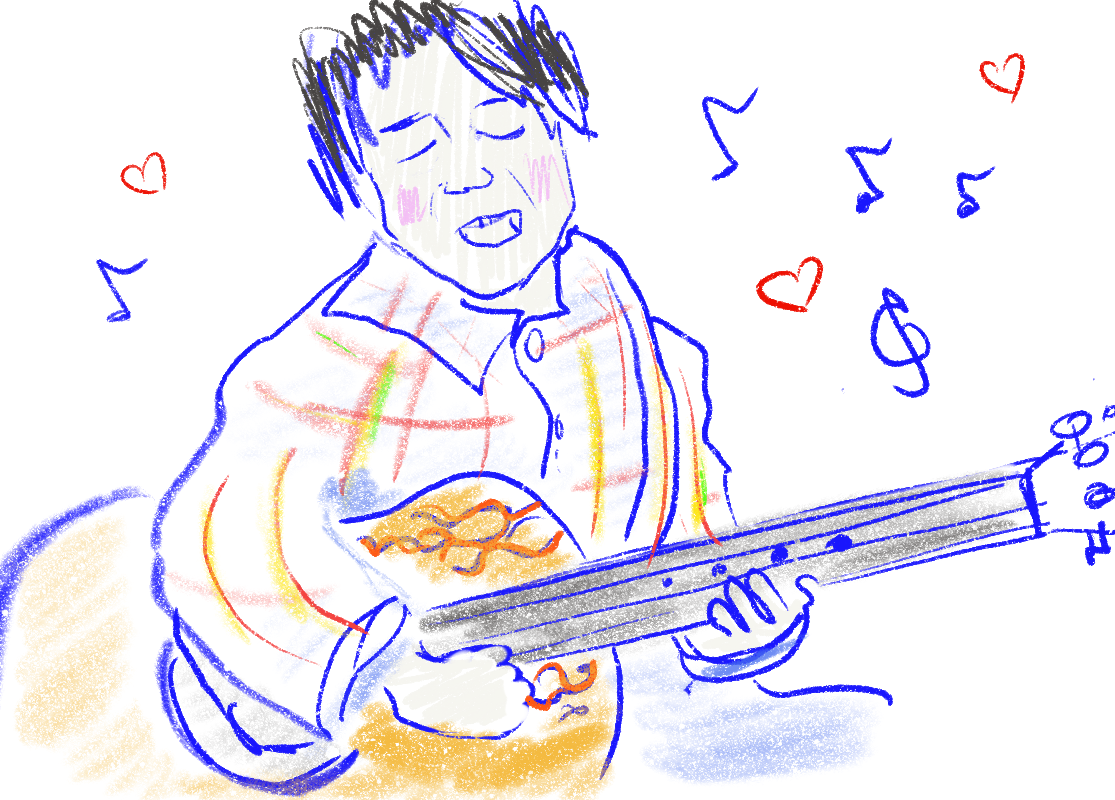
Preschool and early school age are times when a child's creative attitude is formed. During this period, children are incredibly creative, their actions are spontaneous, not based on fixed patterns. Observing the world around them, children naturally interact with nature and art. Adults – parents and teachers – assist them in discovering and consolidating their aesthetic taste. One element of their influence should be creating conditions for the child’s interaction with music. It turns out that, apart from obvious benefits such as the development of creativity, music positively influences the overall development of a young person.
Creating and listening to music positively impact the development of certain higher brain functions. Interestingly, it supports the acquisition of mathematical skills. It helps in shaping the sense of time and space, understanding and using symbols and numbers. Interacting with music allows certain experiences to be used to understand mathematical concepts. Learning song lyrics develops memory and language skills. It expands vocabulary, practices proper articulation. Listening to music also positively influences learning foreign languages.
Dance, beloved by younger children, allows for the expression of emotions, develops body awareness, visual-motor coordination, spatial orientation, and satisfies the natural need for movement. Playing an instrument requires strong concentration, teaches systematicity and perseverance.
Parents can develop their child's musical interests through, among others:
− Joint listening and free interpretive movement to favorite songs
− Organizing interesting, family musical events, e.g., "I've Got Talent", "Name That Tune?"
− Creating props for shared dancing
− Constructing musical instruments from available materials, e.g., empty bottles, beans, rice. Playing together, finding differences in the sound of instruments
− Going to the opera, concert. Exchanging experiences and observations
Musical games:
• "Pause."
We move to the rhythm of the music. We stop when it becomes quiet.
• "High-Low."
We walk on tiptoes when we hear high sounds. We squat when we hear low sounds.
• "Do as I do."
We perform movements to a musical piece. The child's task is to imitate them. Then we switch roles.
• "Sound riddles."
Play a recording for the child. Their task is to guess which instrument makes such sounds.
• Drawing in the air with a finger the content of the heard song.
• Painting the content of songs on large sheets of paper with paints.
• Showing the mood of the piece using movement and facial expressions.
• Inventing lyrics to any simple melody.
Pedagogue Klaudia Sokołowska-Baryś for Marioinex Education Bibliography:
- Kisiel M., Music in Integrated Early School Education, Katowice 2006
- Podolska B., Music in Preschool, Krakow 2008