

What Is the Sense of Balance?
The sense of balance is a complex sensory system that begins to develop already during fetal life, but it is not fully formed until adolescence. It is responsible for the ability to maintain a stable body posture, coordinate movements, and orient oneself in space. During the first eight years of a child’s life, active stimulation of the vestibular system brings the best results. Its foundation is physical activity.
The Importance of the Sense of Balance for a Child’s Development
The sense of balance has a huge impact on a child’s overall development, as well as on their ability to learn. Proper visual-motor coordination is essential in the process of learning to read and write. Spatial perception, in turn, is crucial in learning mathematics, especially geometry. The sense of balance also affects the ability to maintain attention and concentration, as well as the ability to regulate emotions.
Symptoms of Vestibular System Disorders in Children
A child with vestibular system disorders is often distracted, apathetic, gets tired quickly, has difficulty regulating their emotions, and often experiences problems with learning and social functioning. In addition, somatic symptoms may appear, such as nausea, dizziness, and even difficulties with movement.
Exercises Supporting the Development of the Sense of Balance
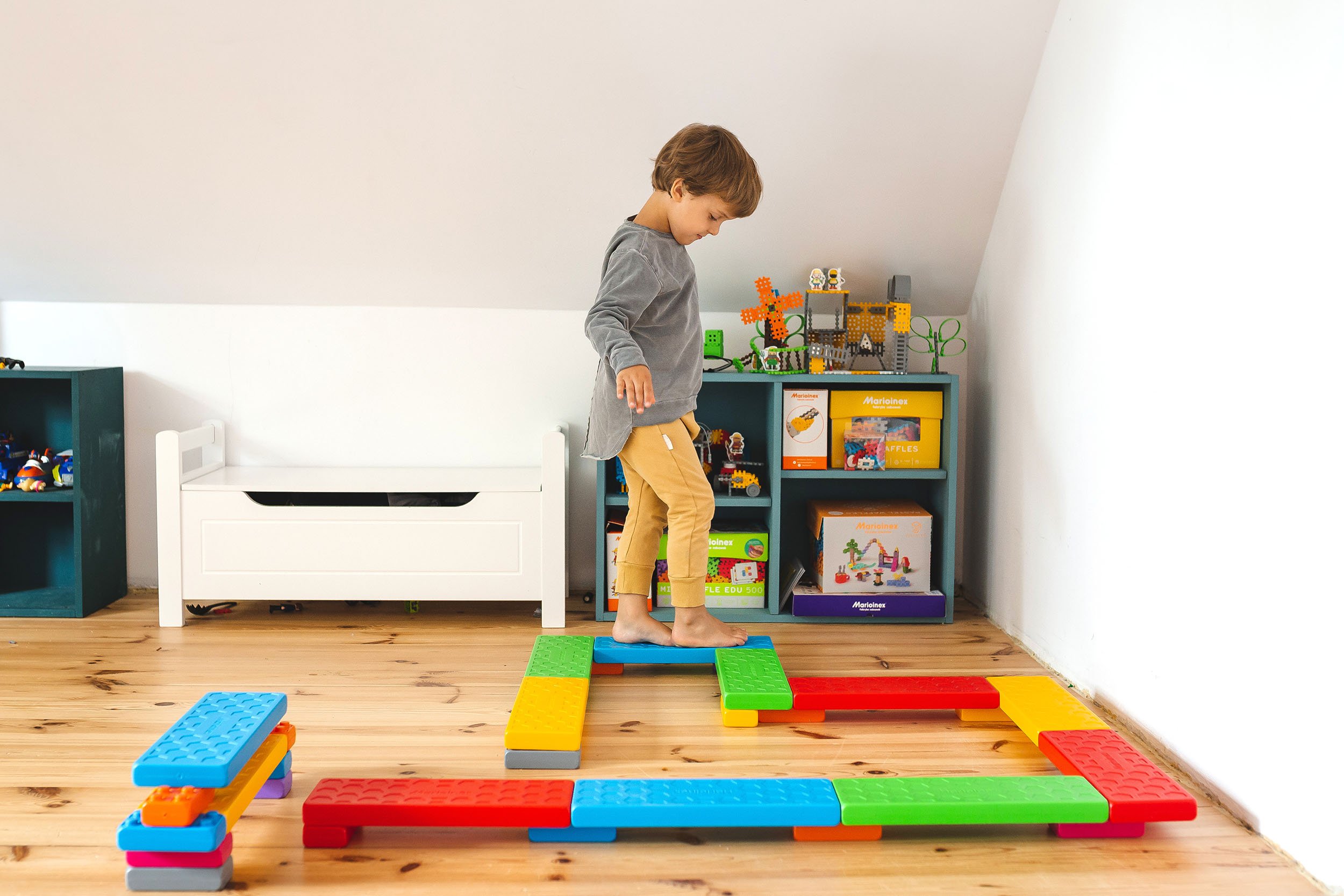
There are many exercises that support the development of the sense of balance. Most of them are used unconsciously during everyday play with children.
Rocking and Swinging:
- Gentle rocking or cradling of a newborn or infant,
- Carrying the child in arms or in a sling,
- Swinging on a swing, in a hammock, or in a blanket,
- “Airplane” play – rocking the child in different directions.
Balance Beam Exercises:
- Walking along a balance beam – facing forward, with side steps, backwards, on all fours, on tiptoes, on heels, on the edges of the feet, with a beanbag balanced on the head,
- Walking along a balance beam while bouncing a ball off the floor,
- Completing an obstacle course,
- Standing on one leg on a balance beam,
- Standing on one leg while moving the arms in both directions,
- Playing on a balance board.
Climbing:
- Climbing gym ladders,
- Climbing a rope or climbing wall,
- Climbing up a slide.
Other:
- Movement games: jumping on a trampoline or inflatable play structures, picking up beanbags with the foot, rolling on the floor, on a large ball, or on a gym roller, walking on tiptoes and heels, riding a bicycle, scooter, skateboard, roller skates, or inline skates. Creative play with our Educational Platforms with Junior Bricks is also great.
- Outdoor games: jumping rope, jumping over elastic bands, playing hopscotch, the “rat” game – one person swings a rope while the others jump over it.
- Dancing and swimming.
In the process of developing the sense of balance, free play is a key element. The parent’s basic task is therefore to encourage the child to engage in regular physical activity while limiting time spent in front of the TV, computer, or smartphone.
Bibliography
Borkowska M., Sensory Integration in Child Development: Neurophysiological Foundations, Gdańsk 2018
Godwin E. P., McKendry A. L., Children with Sensory Integration Disorders, Kraków 2022