

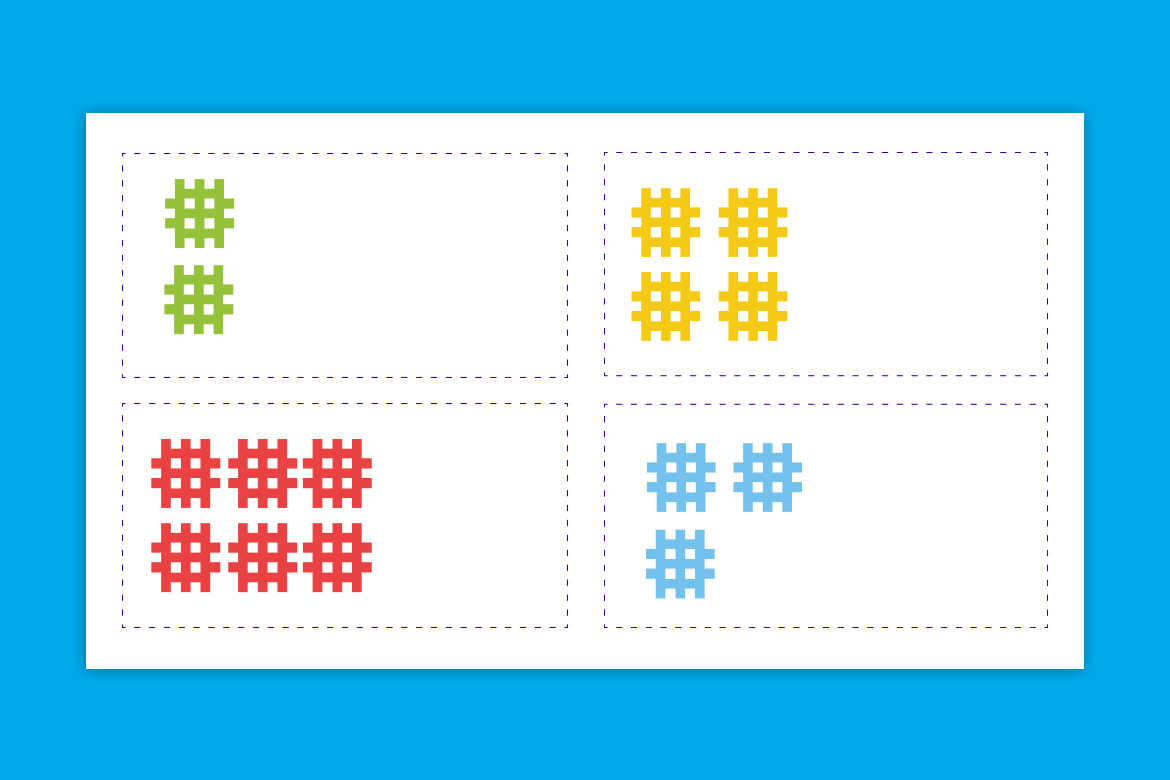
Children in preschool age count, add, and subtract using concrete materials, meaning objects they can freely manipulate and which are directly related to the task at hand (e.g., 'Count all the apples' - the child counts the number of actual fruits). However, this is not always possible, so we use so-called substitute sets in the form of fingers, abacuses, blocks, chestnuts, etc.
Children first encounter the process of addition and subtraction at just two years old. They observe and understand the act of adding (e.g., receiving a few extra candies) and taking away (a parent takes some of them).
Three-year-old children can already independently move objects closer or further away from themselves to perform the appropriate mathematical operation. Then they count all the elements. Younger children often have difficulty remembering ordinal numbers in the correct order, hence we often encounter counting like 'one, two, three, five'. Over time, they can correctly count the elements and give the correct result of the operation.
In the next stage, children achieve the ability to count on and count back. They no longer need to count all the elements. When performing the operation 5+2, they extend five fingers (as they can already associate the number of fingers with a specific number) and add two more.
The final stage in the development of addition and subtraction skills is the transition from concrete to abstract, i.e., counting in memory. At about 6 years old, children already perform simple memory operations, but still use concrete material when performing more difficult tasks.
The ability to add and subtract correctly is, of course, dependent on the child's developmental stage, but frequent and regular exercises are also necessary.
- Adding and Subtracting with Concrete Material.
We prepare chestnuts, beans, counting sticks, blocks, or other aids that will serve as a substitute set:
- We place 4 blocks in front of the child, asking, 'How many blocks do you have?'. The child counts and gives the result.
- We add 2 blocks and say, 'You had 4 blocks, I added 2. How many blocks do you have now?'.
The method of calculation depends on the age and capabilities of the child.
- Older children can additionally arrange operations under the blocks using symbolic notation, e.g., 4 + 2 = 6. We read the written operation together.
Then we switch roles. Children love to set tasks for adults. This makes such exercises great fun. Similarly, we can perform subtraction tasks.
- Tasks with Content.
For older children, we can introduce simple content-based tasks in this way.
- We say, 'Kasia had 5 apples' - the child places 5 blocks in front of themselves.
- 'Tosia gave her 2 more apples' - adds 2 blocks.
- 'How many apples does Kasia have now?' - and again, the child can perform calculations in several different ways (count all the blocks, add 2 more to 5, or perform the calculation in memory).
- Games with Dice - Games for Older Children.
The child throws two dice. Then they add or subtract the number of dots (we can agree that at a given moment we only add or subtract, or prepare cards in two colors, which we will draw before throwing the dice: red color - addition, blue - subtraction).
- 'Three in a Row' - we prepare a 6 x 6 grid board with numbers from 1 to 9 (all squares must be filled, numbers will repeat). We prepare 6 blocks of one color for each of the players. The youngest player throws the dice first and freely adds or subtracts their values. If the result is on the board, the player places their piece on it. Then the next player throws the dice. The winner is the one who first arranges their three pieces in a line (vertically, horizontally, or diagonally).


Pedagogue Klaudia Sokołowska-Baryś for Marioinex Education
Bibliography:
- Dąbrowski M., Not Just Living Numbers! Arithmetic Games for Preschool and Elementary School, Opole, 2017
- Fechner-Sędzicka I., Ochmańska B., Odrobina W., Developing Mathematical Interests and Abilities in Students of Grades 1-3 of Elementary School, Warsaw, 2012.
- Gruszczyk-Kolczyńska E., Zielińska E., Children's Mathematics - Twenty Years Later, Krakow, 2015.