

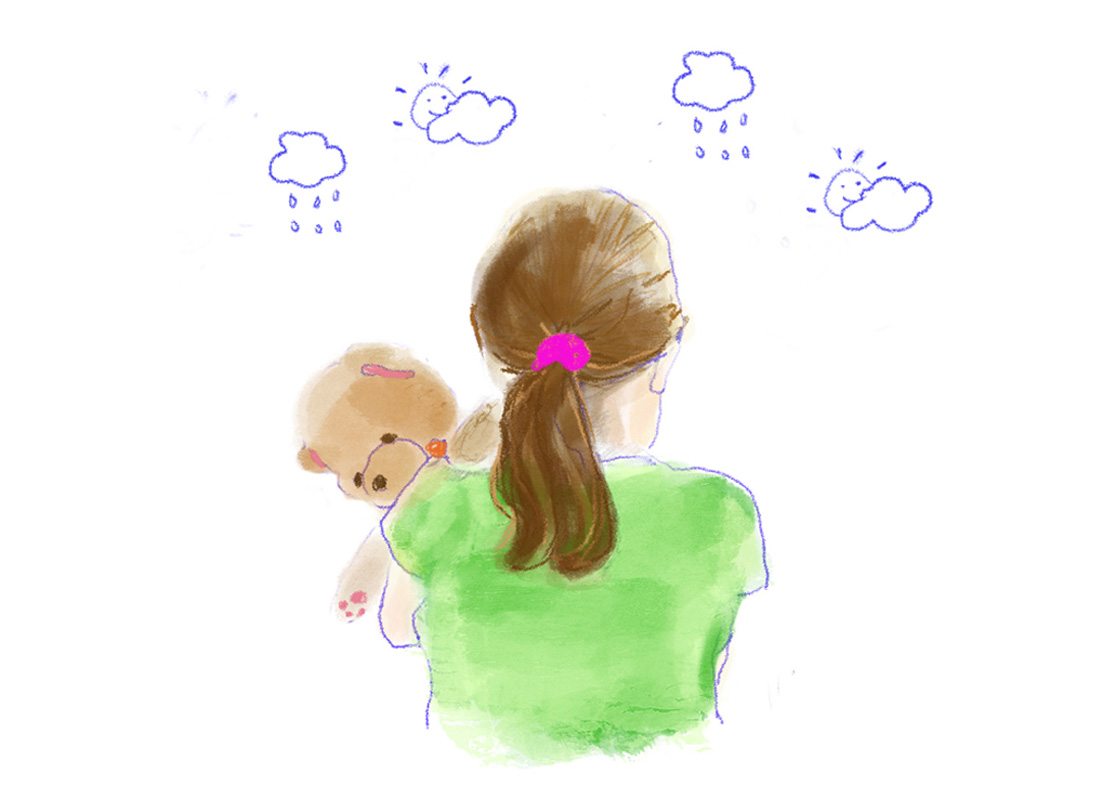
Developmental fears appear at various stages of every child's life. They are related to the development of the nervous system and constitute a natural process of adapting the body to the environment. They usually appear quite spontaneously and do not last long. However, this doesn't mean they should be trivialized. It is important to know what fears are typical for a given developmental stage, how to support the child to help overcome fears and not intensify symptoms, and when fear starts to become a problem.
Depending on the age, children's fears take different forms: auditory, visual, spatial, related to other people. In infants, around the 9th month of life, separation anxiety appears. The child fears being separated from its primary caregiver, reacting with crying and anxiety every time the caregiver is out of sight. Additionally, the infant begins to fear strangers. Small, two-year-old children are afraid of loud, unexpected sounds and dark colors, while two-and-a-half-year-olds are afraid of large objects approaching them. Slightly older children often experience fear of the dark (appearing around the age of 3 and being one of the longest-lasting fears), fear of animals, fear of water, fear of parents leaving, fear of monsters. Six-year-old children experience the most intense states of anxiety. This period sees the emergence of fears of various sounds, ghosts, natural elements, and death of a loved one. Adolescents, on the other hand, have fears of rejection by peers, which intensify with age, peaking around mid-adolescence. Of course, not all fears must occur in every child, and they can also vary in intensity.
How to support a child when they are afraid?
- Talk to the child, try to understand their fear. Do not trivialize it and never mock it.
- Assure the child that you are close and always available to help.
- Explain that fear is completely natural. Everyone (even adults) is afraid of something sometimes.
- Use the 'small steps' method. Gradually familiarize the child with the fear-inducing situation. For example, if your child is afraid of dogs, first read a book about them. You can also watch an animation or a TV program about veterinarians. Look up interesting facts about different breeds online. Then, during a joint walk, observe dogs playing. Maybe after some time, your child will be ready to pet a familiar animal. However, do not force them into any activity, as it may have the opposite effect.
When does fear start to become a problem?
Anxiety disorders affect even one in ten children and are one of the most common types of psychological problems among young people. If your child's fear persists for a long time, is intense, and negatively affects their quality of life, seek help from a psychologist.
Pedagogue Klaudia Sokołowska-Baryś for Marioinex Education
Bibliography:
- Ilg F. L., Ames L. B., Baker S. M., "Psychological Development of the Child from 0 to 10 Years", Gdańsk 2006
- Rapee R. M., Wignall A., Spence S. H., Cobham V., Lyneham H., "Anxiety in Children", Kraków 2017
- Selingger A., "Everyone Gets Scared Sometimes", Sopot 2022