

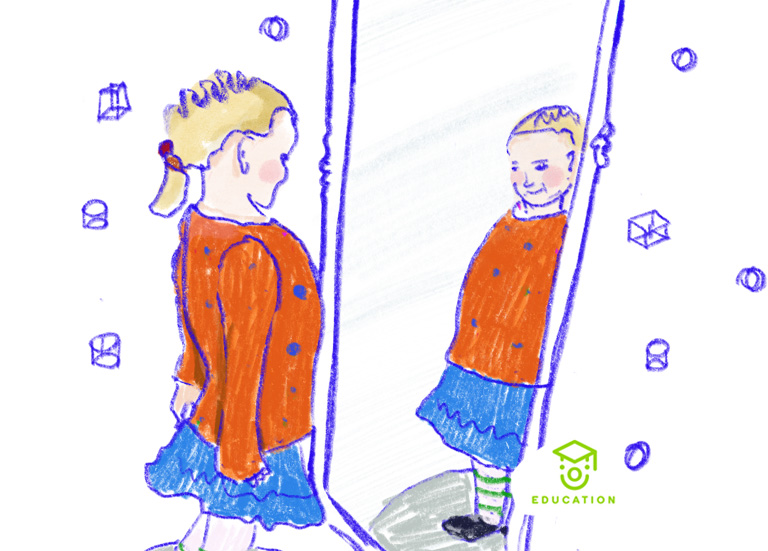
The formation of spatial orientation begins from the very first moments of a child's life. Infants explore the plane, learn to function in it, and cross the body's midline. Although this process is long and often not easy, it is essential for their proper and harmonious development. The only way to learn about space on all its planes is through movement - play, experience, experimentation.
Children in early preschool age gradually develop their spatial orientation. First, they learn to name and point to various parts of their body. Then they can define directions from their body's axis, e.g., "forward," "backward," "to the side," and locate an object relative to their body, e.g., "above me," "below me," "in front of me," "behind me," "next to me," and older children "on my right side," "on the left side." The next stage is orientation in space relative to another person or object, e.g., "The balloon is above Anna." The last skill important in achieving school readiness is orientation on a sheet of paper.
The child involuntarily shapes their spatial orientation during daily activities. There are many simple games and exercises that can help with this.
- Knowledge of one's body schema.
Game suggestions:
-
Greeting with specific body parts, e.g., "We greet each other with our elbows, knees, noses."
-
Pointing to mentioned body parts. The game can be varied by introducing elements of competition - who touches the mentioned body part faster.
-
Rhymes with showing:
My eyes look down, and there feet tap, tap, tap.
My lips smooch, smooch, smooch,
The mouth makes a big O.
My fingers like a dragon, breathe fire whoosh, whoosh, whoosh.
My hands clap so hard that even my ears feel scared!
- Songs like "Head, Shoulders, Knees, and Toes."
- Spatial orientation relative to one's body.
Game suggestions:
-
Placing a chosen object, e.g., a ball, a toy, in a specific place, e.g., "Put the bear on your right side/ above you/ below you/ behind you/ in front of you."
-
"To the target." We blindfold the child. We guide them to the designated target using verbal instructions, e.g., "two steps forward," "a step to the left," "three steps forward."
- Spatial orientation relative to another person or object.
Game suggestions:
-
"To the target." This time we are blindfolded, and the child gives verbal instructions. They lead us to the designated target, e.g., "two steps forward," "a step to the left," "three steps forward."
-
"What do I see?". We stand opposite the child. We ask them to describe what they see, and then try to describe what we see.
-
"Mirror." We stand opposite the child. We make various movements. We ask them to replicate them.
- Orientation on a sheet of paper.
Game suggestions:
-
Playing with a sheet of paper. Pointing, and then marking with a chosen color, the edges (top, bottom, right, left) of the sheet.
-
Completing drawings, e.g., "Draw a colorful flower under the tree."
-
"Spoken picture." "In the top left corner, draw (or arrange with blocks) a sun, below it a cloud. In the very center, draw a house." As time goes on, descriptions can become more detailed. It also allows for practicing attention and memory, as well as careful listening to instructions.
-
"Graphic dictation." On a grid sheet, we mark a point. Then we ask the child to draw according to our instruction, e.g., "Two squares up, one square to the right." As a result, we get a picture, e.g., a house.
Additionally, universal ways of developing spatial orientation in children are playing with blocks (arranging according to a pattern, verbal instruction, free play), assembling puzzles, tangrams, Tetris cubes, mosaics, and various movement games, e.g., with a ball or overcoming an obstacle course.
Pedagogue Klaudia Sokołowska-Baryś for Marioinex Education