

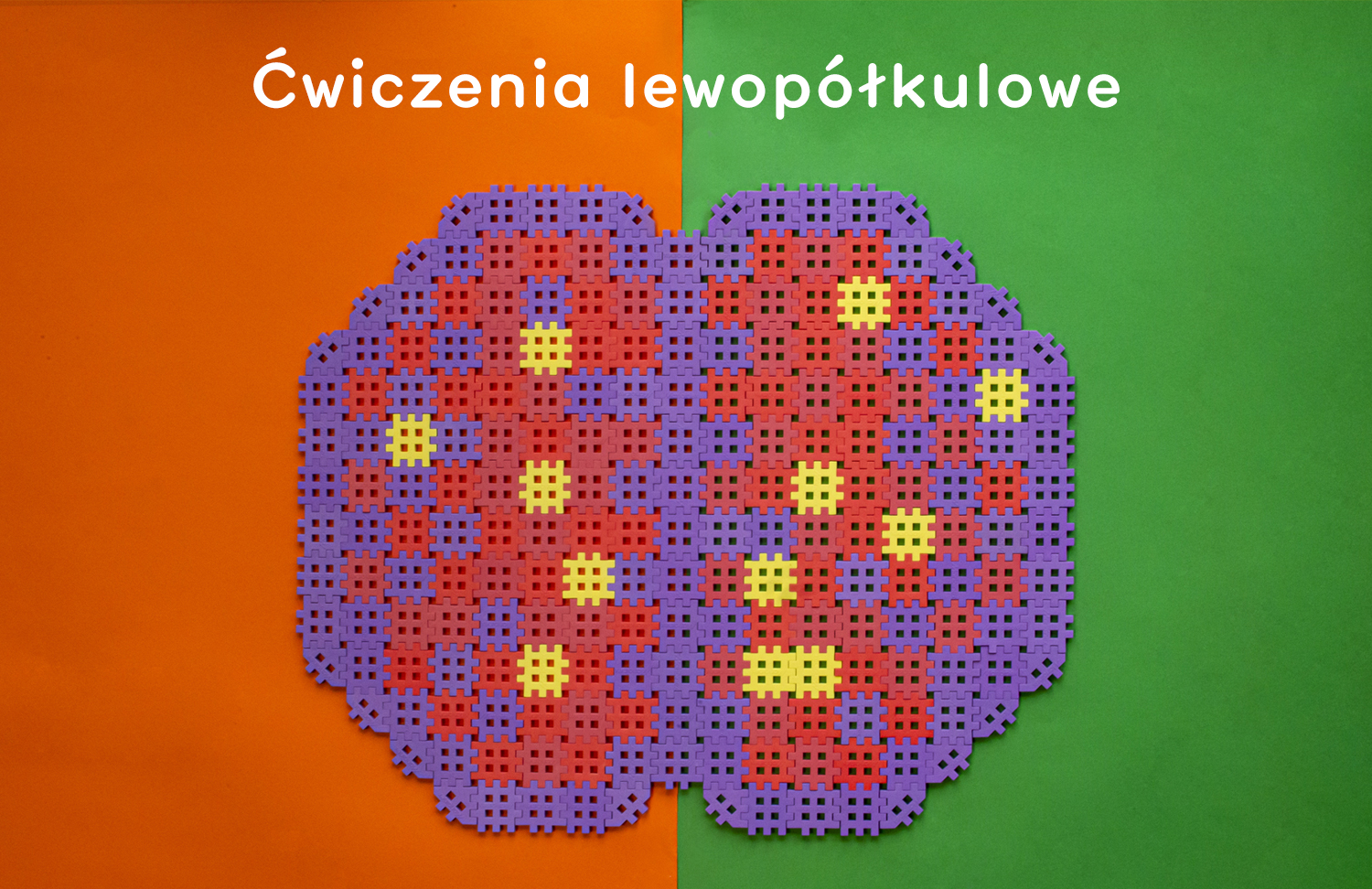
Left Hemisphere Exercises
These exercises target the left hemisphere of the brain, which is responsible for functions such as:
- Analytical and logical thinking,
- Mathematical skills,
- Reading,
- Writing,
- Speech reception and production,
- Noticing differences,
- Combining and organizing facts.
Left hemisphere exercises stimulate the development of processes necessary for a child to be ready for school learning.
Visual Sequences
-
Recreating Sequences: Ask the child to arrange blocks in the same order as shown in a picture.

-
Continuing Sequences: Start with two-element patterns, then gradually increase the number of consecutive blocks.

-
Finding the Missing Element and Completing Sequences.

-
Creating Sequences Independently: The child creates their own sequence from available elements. Then an adult or another child tries to recreate it.

Auditory Sequences
-
Repeating Rhythms: Tap a rhythm without the child seeing your hand. Then ask them to repeat the heard sounds. Start with two- and three-element sequences.
-
Breakfast Game: Say, "For breakfast, I ate...". This game works well in a larger group of children but can also be used at home. For example, "For breakfast, I ate cheese". The child repeats the whole sentence and adds their word, e.g., "For breakfast, I ate cheese, ham". In a larger group, the game continues until each child adds one ingredient. At home, you can play alternately adult-child-adult.
-
Recipe: Ask the child to sequentially add ingredients to a bowl to cook a delicious dish. This can be done with real ingredients or with blocks or printed illustrations.
Motor Sequences
- Repeat My Dance: Perform two movements, e.g., clapping hands, jumping. Ask the child to repeat. Then switch roles. Gradually increase the number of movements.
Relationships
-
Match Pairs: Ask the child to match two identical pictures.
-
Finding Differences: Give the child two seemingly identical pictures. Then ask them to point out or mark the differences.
-
Which Picture Doesn't Belong?: Give the child several drawings, e.g., of toys, and one of furniture. Ask them to point out which picture doesn't belong and explain why.
-
Coding Games: Currently very popular, they positively influence the development of logical and analytical thinking and the ability to detect and correct errors. Children can experience coding both online and offline.

Games for Older Preschoolers
-
Detecting Details: Finding the mismatched letter. Give the child a sheet filled with several letters, e.g., "d". Among them, include a letter of similar structure, e.g., "b". Ask the child to find and mark the mismatched letter.
-
Counting Signs: Give the child a card with randomly written letters and numbers. Ask them to find and count, for example, all the number "5"s or all the letter "e"s.

Pedagogue Klaudia Sokołowska-Baryś for Marioinex Education
Bibliography:
- Bragdon A.D., Gamon D., Exercise Your Mind, K.E.Liber, Warsaw, 2008
- Cieszyńska-Rożek J., The Krakow Method in the Face of Developmental Disorders in Children, Krakow, 2012