

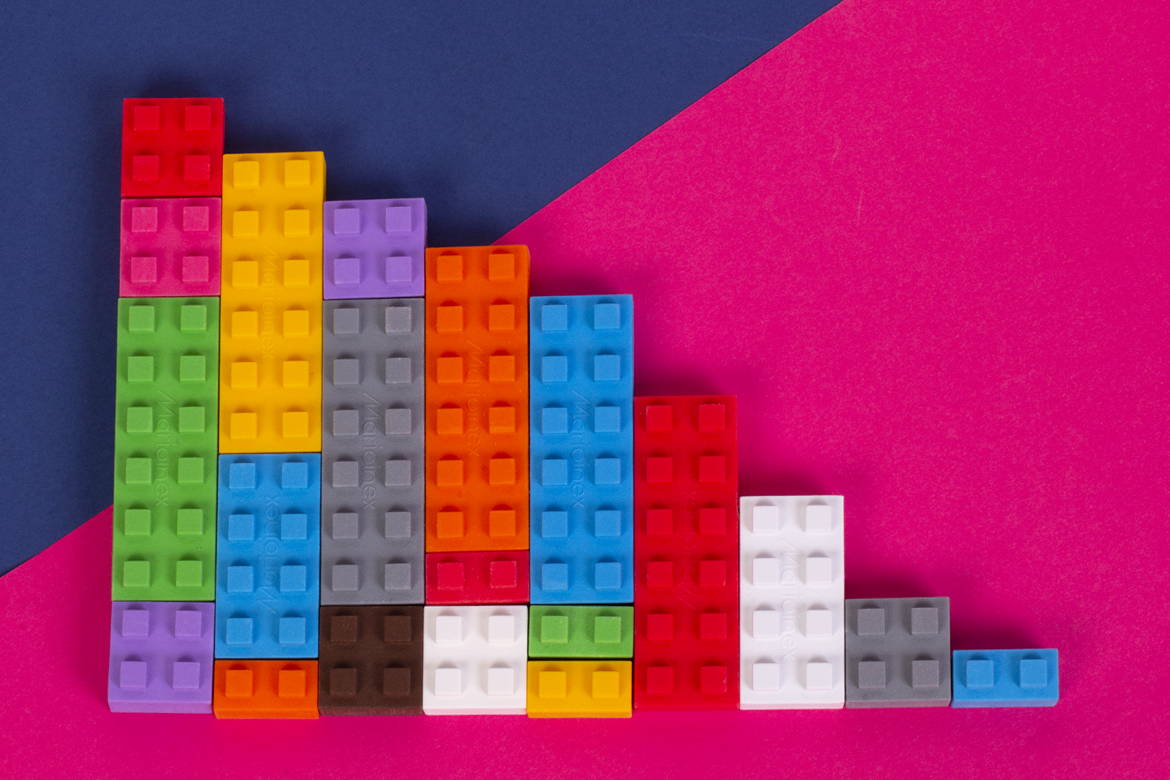
The ability to measure length depends on many factors, including a child's capacity for operational reasoning in terms of maintaining constancy within continuous quantities. In practice, this means that a child, seeing two strings of identical length, should be able to deduce that even after changing the arrangement of one of them, the strings will still be of the same length. Children typically achieve this level of operational reasoning in measuring around the age of 8. Below are several exercises that can support this developmental process.

-
Games Involving the Child's Silhouette: We start with exercises related to the child's silhouette. We ask them to indicate an object that is taller or shorter than themselves. We emphasize that in measuring, we consider two points – the beginning and the end of the object. A high-hanging object is different from a tall object.
-
Games Based on a Child's Experiences and Surroundings: We can compare two different objects. We ask the child questions like, "What is taller, a robot or a ball?", "Which doll is taller?".
-
Guessing Games: We say, "The object I'm thinking of is taller than me," and if there are too many options, we can narrow it down by adding, "It is red in color." Then we switch roles – now the child thinks up and poses a riddle.
-
Exercises with Blocks: We prepare ten blocks of the same length and arrange them in two lines. We ask the child if they are the same. Then we modify one of the lines, for example, by arranging it in a zigzag. We ask which line is longer. If the child thinks the straight line is longer, we ask them to rearrange the blocks in the previous layout and discuss what they noticed, without suggesting an answer.
-
Measuring with Feet, String, Blocks: During measuring with feet, we ask the child questions like, "Why do you think I measured this distance with ten steps, and you with thirteen?", "What will happen if we cut this string in half? To measure this length, will we apply it five times again?".

-
Task with CLASSIC Blocks from Marioinex: We arrange two blocks, for example, with 4 and 6 dots. We ask the child to arrange a similar line using different sizes of blocks. Then we remove one block and ask, "Which line is longer? By how many dots?".
We introduce concepts related to units of measurement and methods of measurement using tools only after the child has no difficulty performing the above exercises.
All available CLASSIC block sets can be found HERE >

Pedagogue Klaudia Sokołowska-Baryś for Marioinex Education
Bibliography:
- Fechner-Sędzicka I., Ochmańska B., Odrobina W., Developing Mathematical Interests and Abilities in Students of Grades 1-3 of Elementary School, Warsaw 2012.
- Gruszczyk-Kolczyńska E., Zielińska E., Children's Mathematics – Twenty Years Later, Krakow 2015.
- Skura M., Lisicki M., Mathematics in Action, Warsaw 2016.