

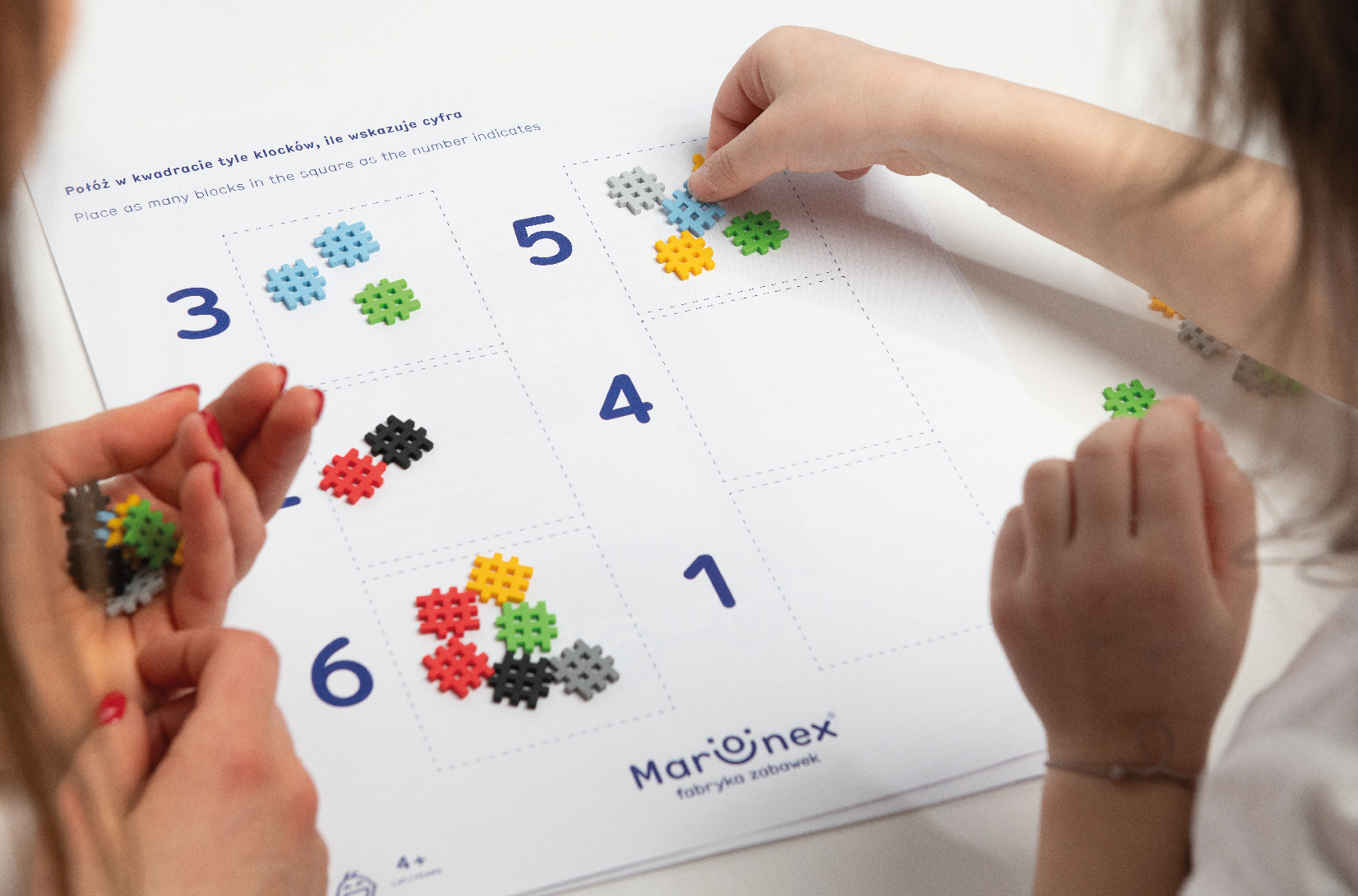
Multiplication is one of the four basic arithmetic operations that are also essential in adult life. Understanding its essence is a complex and seemingly difficult process. It requires the ability to think abstractly. Properly selected exercises using concrete materials will help a child understand multiplication and excellently handle even the most difficult word problems in the future.

Understanding the concept of 'multiplication'.
- We prepare Micro Waffle blocks and squares cut out of colored paper.
- We create sets with the child. We lay out 3 squares, putting 3 Micro Waffles on each. We ask the child to calculate how many blocks are in all the squares. Then, we ask them to write down the operation themselves (3 + 3 + 3 = 9). We explain that multiplication replaces addition when we deal with several of the same components (when we add the same numbers). We show the multiplication notation: 3 × 3 = 9.
- We explain: on three squares, we put 3 blocks each. We ask the child to create sets according to their own idea, e.g., 3 squares, each with 5 blocks. Again we write down addition and then multiplication. We repeat the task until the child understands the concept.
We write down an operation on paper, e.g., 4 × 2 = We ask the child to arrange the sets and then solve the operation.
- We say: place 4 squares, put 2 blocks on each, or the other way around: place 2 squares, put 4 blocks on each. This is a good moment to make the child realize that multiplication is commutative – we can change the order of the factors, and the result will remain the same. We repeat the task until the child understands the concept.
Introduction to word problems
- We present the child with a simple word problem, e.g., There are 6 flower beds in the garden. In each bed, 2 flowers grow. How many flowers are growing in the garden?
- Together with the child, we arrange blocks according to the content of the task, i.e., 6 beds, in each 2 flowers. We ask the child to count all the blocks. Then we write down the addition together: 2 + 2 + 2 + 2 + 2 + 2 = 12.
- We ask the child to think about how to shorten this operation. Together we write: 6 × 2 = 12 or 2 × 6 = 12.
Multiplication by 0
We tell the child that no matter what number we multiply by 0, the result will always be 0. We explain with an example, e.g., 0 × 4. We say: 0 times put 4 blocks. How many blocks did you put? Now the other way: 4 times put 0 blocks. How many blocks did you put?
Multiplication by 1
Similarly, we proceed with explaining multiplication by 1. We say: 1 time put 4 blocks. How many blocks did you put? Now the other way: 4 times put 1 block. How many blocks did you put? We repeat this task several times. The child will notice and remember the pattern of multiplication by 1.
You can find our Micro Waffle HERE.
Pedagogue Klaudia Sokołowska-Baryś for Marioinex Education
