

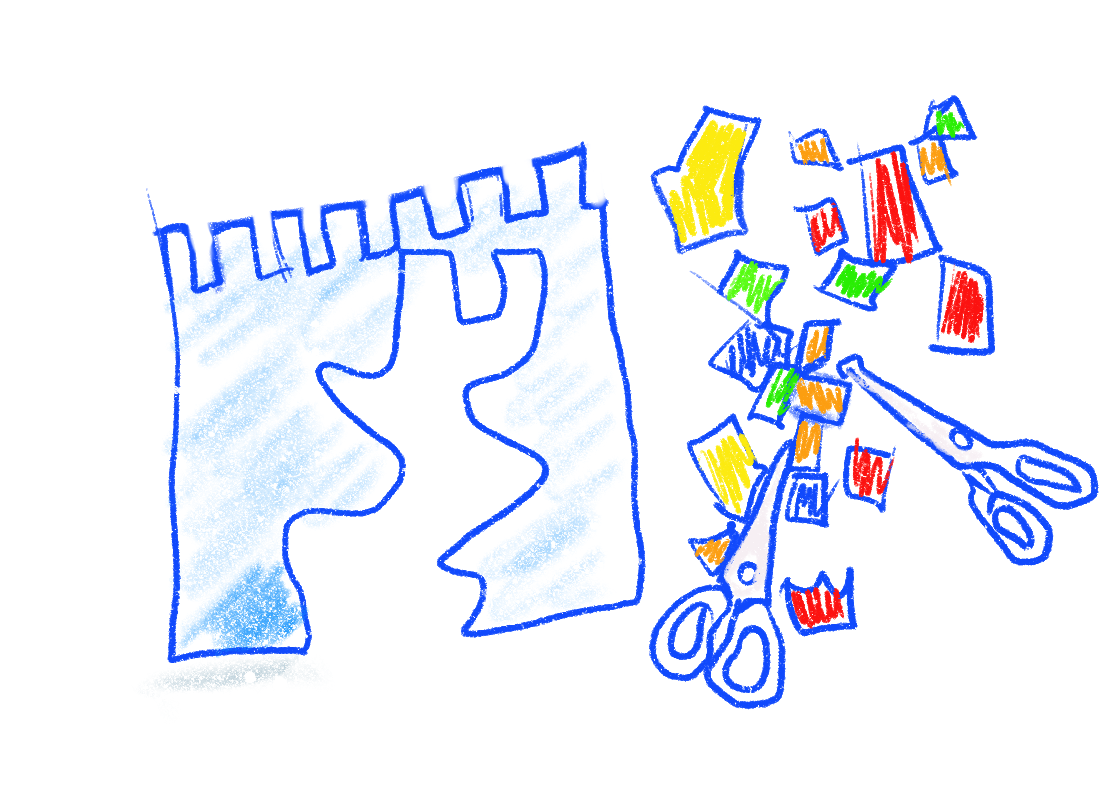
When to give children scissors? – a question all parents ask themselves. On one hand, they want their child to acquire new skills, but on the other, they worry about potential harm. The answer is simple: as early as possible!
It's worth starting to play with scissors between the ages of 2 and 3. To ensure it's effective, appealing, and most importantly safe, it's worth following a few simple rules.
- Safety
Scissors should have rounded blades. An additional advantage would be a cover that facilitates safe carrying and storage. Children should only use scissors in the presence of an adult! From the very beginning, establish rules for using scissors: sit while cutting, point the blades towards the paper, never towards the face, and carry scissors in a case or holding the closed blades downwards. - Quality
The first pair of scissors should be of really good quality. Before purchasing, it's worth checking if they are sharp, what material the blades are made of (plastic or tin won't do), and how they feel in the hand. Some children’s scissors are not suitable for cutting anything! They can cause the child to become discouraged quickly. - Size
and Shape Scissors should be suited to the size of the child's hand. For 2-3-year-olds, you can buy scissors with a universal handle. If there is a clear dominance of one hand, consider buying profiled scissors – for right or left-handed users.
Where to Start?
Initially, learning to use scissors can be difficult and frustrating. In this case, it's worth applying the principle of gradually increasing difficulty. Don’t ask the child to cut complex figures if they haven’t mastered cutting in a straight line yet. Over time, cutting will become one of the child's favorite activities!
- Grip
Firstly, show the child how to hold the scissors. We may need to return to this stage from time to time. Fortunately, the grip of children's scissors somewhat forces the correct placement of the fingers. - Snipping
Prepare narrow strips of paper. Show the child how to snip them. Then, hold individual strips while the child learns to use their first scissors! You will see concentration on their face, sometimes frustration, but certainly joy with each successful attempt! You can diversify the play by preparing, for example, grass or hair strips that the child will trim. - Cutting along a Line
Ensure the line is thick and clear. Start with straight lines, then progress to broken and wavy ones. Gradually increase their length. - Cutting Out
Start with simple shapes: square, triangle, rectangle. Cutting out more complex, detailed shapes, such as animal contours, requires more precise movements. Older preschoolers will be able to handle such a task.
Pedagogue Klaudia Sokołowska-Baryś for Marioinex Education Photo: @sigmund