

Initially, it's important to note that the development of fine motor skills is closely linked to the overall physical fitness - gross motor skills. Therefore, physical activity in the early years of a child's life is extremely important for their development. We should provide them with as many opportunities as possible for active time through, for example, movement and music-movement games, walks, gymnastic exercises. Gross motor skills allow for activities such as walking, jumping, throwing and catching a ball, climbing and descending stairs, maintaining balance.
Fine motor skills, in the broadest sense, refer to the dexterity of hands and fingers. They enable the development of skills requiring precision movements, such as fastening and unfastening buttons, grasping and transferring small objects, tying shoelaces, and eventually replicating shapes and writing.
A high level of motor functions promotes the development and consolidation of the correct grip of a writing instrument, which in turn affects the ability to correctly replicate and connect letters, and fit within lines. It also allows writing at a good pace, reducing the problem of rapid hand fatigue.
Exercises developing fine motor skills should be based on play. It's important that they are enjoyable and attractive for the child. A basic exercise like kneading balls from old newspapers can be varied by introducing a competitive element – a target throwing competition. Don't make the child repeatedly thread beads on a string, only to destroy their work in front of their eyes moments later. Suggest they make a bracelet for an aunt or grandmother. All exercises can be attractive!
A few examples of fine motor skill development exercises based on play:
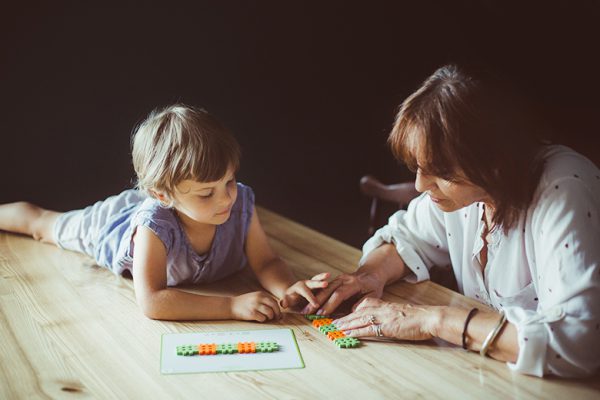
- Building with blocks – even a few months old children develop fine motor skills by grabbing and manipulating blocks (suitably chosen for their age).
Children can build vehicles, roads, buildings, and also arrange sequences, make simple classifications. The possibilities are endless!
- Cutting with scissors.
Laborious cutting along lines? – definitely NOT! Let it be part of your work on your "Happy Monster". Prepare a cardboard tissue box, paint it together with large brushes/sponges. Cut out and stick on eyes and teeth. Make the Monster a funny hairstyle from the cut strips. Name it, and then use it for play and learning. Example of an educational game:
- Prepare cards with letters.
- Decide that at a given moment the monster eats only vowels.
- Ask the child to feed it using only the right "food".
- Painting with paints on large sheets of paper, e.g., waves, mountains, loops
Example: the child paints the body of a lamb using loops. Make sure the movements are smooth, and the child rarely lifts their hand from the paper. Then add the missing body parts of our lamb.
- Finger games.
From traditional finger games like:
- "Greeting all the little fingers" – children connect the fingers of both hands one by one, then detach them.
- "Bear's cave"
"Here is the cave" – show a fist,
"inside is a bear" – put the thumb inside,
"Please bear, come out" – tap the other hand on the fist,
Oh! The bear came out! – pull out the thumb.
to new, more engaging finger games. I especially recommend the book by Aneta and Piotr Winczewski "Completely New Finger Games. Improving the Hands of Children".
- Sewing.
On a sheet from a technical block, print a large image, e.g., a heart, cloud. Cut it out or ask the child to do so. With the thickest needle, punch around the pattern about 2 cm from the edge. Ask the child to thread the needle with embroidery floss (plastic, safe needles are available online), tie a knot at the end. Show the child how to thread the floss through the holes.
- Playing with modeling materials – playdough, foam clay, modeling clay, and perhaps a bit forgotten – salt dough.
Games using modeling materials can be both directed ("create the letter w") and free (the child decides what to mold).
Preparing a child for learning to write is a complex and long process. It is based on exercises of fine and gross motor skills and visual, auditory, and tactile perception. With proper stimulation, we can help the child master this difficult skill. Therefore, it is worth applying both numerous exercises developing the child's overall fitness and exercises for the hands and fingers on a daily basis.
– Educator Klaudia Sokołowska-Baryś for Marioinex Education
Bibliography:
- Kielar-Turska M., Białecka-Pikul M., Early Childhood [in:] Harwas-Napierała B., Trempała J., Human Development Psychology, PWN Scientific Publishing House, Warsaw, 2000, volume II
- Piotrowska-Madej K., Żychowicz A., Smart Hand Model. Diagnosis and Therapy of the Hand in Children, Harmonia Publishing House, Gdańsk, 2018
- Winczewska A., Winczewski P., Completely New Finger Games. Improving the Hands of Children, Harmonia Publishing House, Gdańsk, 2018