

Knowledge of the multiplication table is essential both in the educational process and in everyday life. Understanding and being able to apply its principles is the foundation for more advanced mathematical operations. Below we present several ways to make learning the multiplication table much more enjoyable.
Initially, it's worth acquainting the child with the basic principles of multiplication:
- Multiplying by 0 always results in 0.
- Multiplying a number by 1 always gives the same number, for example: 1 × 3 = 3, 1 × 7 =7
- The result of multiplication is independent of the order of the numbers multiplied, for example: 3 × 7 = 21, 7 × 3 = 21
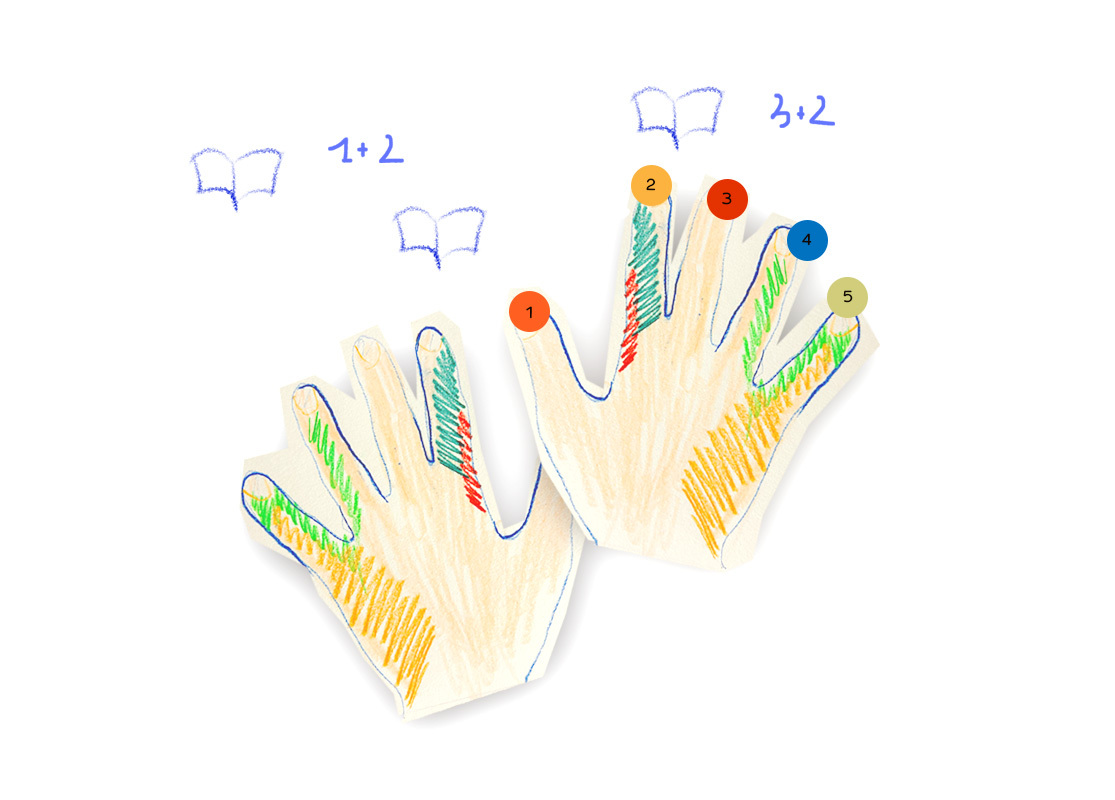
Multiplication by 2 and 3
Turning multiplication into addition. This method works only for small numbers.
2 × 4 is 4 + 4
3 × 4 is 4 + 4 + 4
Multiplication by 5
Count by 5s, using each finger as a counter.
Multiplication by 9
Multiply the number by 10 and then subtract it from the result. Example: To calculate: 9 × 8
Example 2: To calculate: 9 × 4
- Multiplication on Fingers
Stretch out 10 fingers. Bend the finger corresponding to the number by which we are multiplying. Fingers on the left are tens, on the right are units.
Geometric Multiplication
This method works when we have more time to give the result.
Using lines, we draw the numbers we want to multiply. The number of points where they intersect is the multiplication result.
The multiplication table should be memorized for life. So, how to effectively reinforce it? The best way is through play!
- Dice Multiplication
Each participant rolls two dice. Multiplies the number of dots by each other. For each correct answer, they receive a point.
- Who's First?
Prepare cards with operations. Stack them. The first participant takes a card and places it in the middle of the table. Whoever first gives the correct result takes the card. The winner is the player who collects the most cards.
- Prepare cards with operations and separate cards with their results. Place the operation cards in a stack. Distribute the result cards among the players. The first participant takes a card and places it in the middle of the table. The task of all players is to quickly find the result among their cards and place it next to the operation.